 How-to
How to Avoid Drivetrain Issues When Hauling Heavy Loads
Last Updated: November 8, 2026
Quick Summary
To avoid drivetrain issues when hauling, stay inside your truck's towing capacity and payload limits, keep transmission fluid fresh, and use tow/haul mode so the transmission shifts less on grades. Check U-joints, driveshaft, differential, and transfer case fluid before and after every haul to catch small problems early.
- Weigh your rig at a public scale to confirm you are inside each axle rating.
- Add an auxiliary transmission cooler if your truck lacks a towing package.
- Use manual mode and a lower gear on long descents to let engine braking work.
- Follow the severe-service fluid interval in your owner's manual, not the standard one.
- Load heavier items over the trailer axles and keep tongue weight in the manual's range.
Table of Contents
- Why Hauling Strains the Whole Drivetrain, Not Just the Transmission
- Stay Inside Your Truck Towing Capacity and Payload Limits
- How to Keep Transmission Cool When Towing
- Signs of Transmission Overheating While Towing and What to Do
- Gear Selection and Tow/Haul Mode on Hills and Heavy Loads
- Transmission Fluid Maintenance for Towing
- Trailer Setup and Load Distribution That Spare the Driveline
- Pre-Trip and Post-Trip Drivetrain Checks Before Your Next Haul
- Frequently Asked Questions
Why Hauling Strains the Whole Drivetrain, Not Just the Transmission
Most drivers blame the transmission when a tow rig starts acting up. That is rarely the full story. Learning how to avoid drivetrain issues when hauling means thinking about every part that turns engine power into forward motion: the transmission, driveshaft, differential, axles, U-joints, and the cooling systems that keep them alive.
A stock truck rated for a load can still wear out fast when the load sits high, the trailer is unbalanced, or the driver fights the throttle on every grade.
The transmission takes the heat, but the stress spreads. If you want to see how that compares with a modified stock truck, our breakdown of custom Sport Chassis vs stock trucks for heavy towing explains the difference.
Stay Inside Your Truck Towing Capacity and Payload Limits
The single best defense against drivetrain damage is staying under your ratings, but the ratings only help if you know how to read and verify them. Towing capacity is the maximum weight your truck can pull. Payload is the weight it can carry, including passengers, cargo, and the tongue weight of the trailer. Both numbers live on the door jamb sticker, and the owner's manual lists the axle limits, tire limits, and required towing equipment that go with them.
Start with the sticker on the driver's door jamb. It shows the gross vehicle weight rating (GVWR), the gross axle weight rating (GAWR) for each axle, and the tire load limits. The owner's manual adds the gross combined weight rating (GCWR) and the maximum trailer weight for your specific cab, bed, axle ratio, and drivetrain configuration. Do not rely on a brochure number for a different trim level; the same model year can carry different ratings depending on how it was built.
- Tongue weight: keep it in the range your manual lists, usually a set share of trailer weight
- Combined weight: truck plus trailer plus everything inside
- Axle ratings: each axle has its own limit, and rear axles hit theirs first
- Tire limits: the tires, not the springs, often set the real ceiling on a loaded rear axle
A public scale is the only way to confirm what you are actually carrying. Weigh the truck empty with a full tank, then weigh the truck and trailer together with the trailer loaded. The difference gives you the true trailer weight, and the steer and drive axle readings tell you whether you are inside the GAWR. A common pattern is a rig that is under the advertised tow rating but over the rear axle rating because of tongue weight and cargo behind the cab.
Overloading strains the transmission, the rear axle, and the brakes all at once. It also voids many warranties. If you are unsure which class your truck falls into, our guide on what makes a truck heavy duty walks through classes and GVWR.
How to Keep Transmission Cool When Towing
Heat is what kills automatic transmissions under load. A transmission cooler is the most direct fix, and many trucks sold with a towing package already have an auxiliary cooler mounted in front of the radiator.
If yours does not, adding one is a smart upgrade before your first heavy pull. Keep the cooler and radiator fins clean, because bugs and road grime block airflow. On long climbs, drop a gear early rather than waiting for the temperature gauge to climb.
Signs of Transmission Overheating While Towing and What to Do
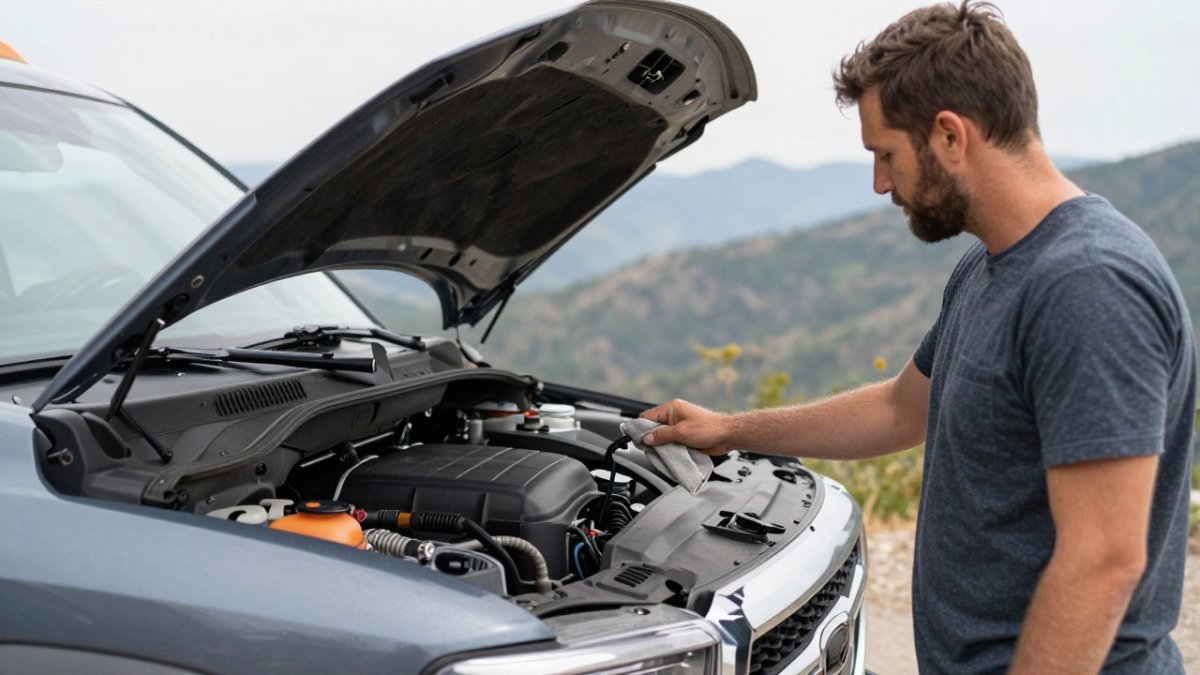
Watch for these warning signs of transmission overheating while towing: a burning smell, slipping between gears, delayed engagement, or a temperature gauge climbing past its normal range. Any of these means pull over safely and let the transmission cool.
Do not keep driving to "see if it clears up." Heat damages clutch packs and seals, and that damage is permanent.
Once stopped, check the fluid level and condition. Dark or burnt-smelling fluid points to heat damage. If the gauge stays high after cooling, have the truck inspected before towing again.
Gear Selection and Tow/Haul Mode on Hills and Heavy Loads
Tow/haul mode is not a gimmick. It holds gears longer and shifts later, which keeps the engine in its power band and reduces gear hunting on grades. Gear hunting is the constant up-down shifting that spikes heat and wears clutches.
Use manual mode on long descents. Pick a lower gear, let engine braking do the work, and keep your foot off the brake pedal. Second gear and first gear are your friends on steep grades.
If you are wondering whether one truck can handle both heavy towing and daily driving, read our take on whether one truck can do both.
Transmission Fluid Maintenance for Towing
Transmission fluid maintenance for towing is not the same as for a commuter car. Heavy loads generate more heat, and heat breaks fluid down faster. Follow the severe-service interval in your owner's manual, not the standard one.
- Check fluid level and condition monthly during towing season
- Replace the filter with the fluid when the schedule calls for it
- Use the exact fluid spec listed in your manual
- Have the fluid changed sooner if it looks dark or smells burnt
Fresh fluid carries heat away and keeps the valve body shifting cleanly. Skipping it is one of the most common ways drivers invite drivetrain issues.
Trailer Setup and Load Distribution That Spare the Driveline
A badly loaded trailer punishes the driveline. Too much tongue weight overloads the rear axle and lifts weight off the front wheels. Too little makes the trailer sway and forces constant steering corrections that stress the whole truck.
Load heavier items over the trailer axles. Keep the tongue weight inside the range your manual specifies. Make sure the hitch height matches so the trailer sits level.
Proper load distribution keeps the driveline in its designed working range. For help matching a truck build to your trailer, our guide on planning custom truck builds for horse trailers covers the setup step by step.
Pre-Trip and Post-Trip Drivetrain Checks Before Your Next Haul
Most towing advice stops at the transmission. The drivetrain is bigger than that, and a short inspection before and after every haul catches small problems before they strand you with a loaded trailer. Run through this checklist each time:
- Check transmission fluid level and color
- Look for leaks under the transmission, transfer case, and differential
- Inspect U-joints and driveshaft for play, rust dust, or vibration
- Check differential fluid level and look for a wet pinion seal
- Check transfer case fluid level on 4WD trucks
- Inspect engine and transmission mounts for cracks or sagging
- Confirm tire pressure on truck and trailer, and check for uneven wear
- Test trailer lights and brake controller
- Listen for new noises on the first mile
Each item points to a specific failure mode. A vibration that builds with speed often means a failing U-joint, a dented driveshaft, or a lost balance weight. A clunk when you shift from drive to reverse can point to a worn U-joint or a loose mount. A wet spot at the rear differential usually means a pinion seal is seeping, and a low differential will howl and wear quickly under load. On 4WD trucks, the transfer case takes its own heat and needs its own fluid check.
Watch out: a small vibration at speed often means a failing U-joint or an unbalanced driveshaft, and ignoring it can turn into a roadside breakdown with a loaded trailer.
After the haul, repeat the leak and fluid checks while the drivetrain is still warm. Heat reveals seeps that are invisible when cold. If you find metal paste on the differential drain plug or burnt-smelling transfer case fluid, service it before the next pull rather than topping it off.
When patching an aging rig costs more than it is worth, it may be time to look at a truck built for the job. You can view our inventory of heavy-duty trucks set up for towing.
Run through these checks before and after every haul to catch small drivetrain problems early.
| Check | What to look for |
|---|---|
| Transmission fluid | Level and color |
| Leaks | Under transmission, transfer case, and differential |
| U-joints and driveshaft | Play, rust dust, or vibration |
| Differential fluid | Level and a wet pinion seal |
| Transfer case fluid | Level on 4WD trucks |
| Engine and transmission mounts | Cracks or sagging |
| Tire pressure | Truck and trailer, plus uneven wear |
| Trailer lights and brake controller | Test before towing |
Hauling heavy loads does not have to mean constant repairs. The right truck, set up correctly from the start, protects the whole drivetrain instead of just the transmission. At Extreme Sport Chassis, we build and stock SportChassis trucks with heavy-duty engineering, luxury comfort, and towing capability that holds up to real work. Our team helps you match a truck to your trailer, your load, and your daily driving. Get started with Extreme Sport Chassis and haul with confidence.
Frequently Asked Questions
What is the 80% rule when towing?
The 80% rule means keeping your loaded trailer weight at or below about 80% of your truck's rated towing capacity. That buffer covers passengers, cargo, terrain, and summer heat that push the drivetrain harder than the spec sheet assumes. Running at the full rating on every trip leaves no margin for a steep grade or a headwind, and the extra strain shows up as transmission heat and faster drivetrain wear. Weigh your rig at a public scale loaded, then compare that number to the rating in your owner's manual.
Can pulling a trailer damage your transmission?
Yes, if the load exceeds the rating, the fluid is overdue, or heat goes unmanaged. Towing multiplies the torque and heat the automatic transmission handles, and sustained heat is what breaks down transmission fluid and wears clutches. Most damage builds slowly: slipping, delayed shifts, and a burnt smell appear before a failure. Staying within truck towing capacity and payload limits, using tow/haul mode, and following the severe-duty fluid interval in your manual prevent most of it.
How often should you service a transmission used for towing?
Follow the severe-duty or trailer-towing interval in your owner's manual, which is typically shorter than the normal schedule. Many manufacturers list a fluid and filter change somewhere between 30,000 and 60,000 miles for towing use, but your manual is the authority for your specific truck. Check fluid level and condition more often than that, especially before a long haul. Dark, burnt-smelling fluid or grit on the dipstick means it is time to service regardless of mileage.
When should you stop driving if the transmission overheats while towing?
Pull over as soon as the transmission temperature gauge enters the warning zone or a dashboard message appears. Continuing to climb a grade with the fluid overheating accelerates wear fast. Stop in a safe spot, shift to park, and let the truck idle so the cooler and fan can work. Do not open the transmission or add cold fluid to a hot unit. Once temperatures return to normal, resume gently, and if the warning returns, stop for service rather than pushing on.