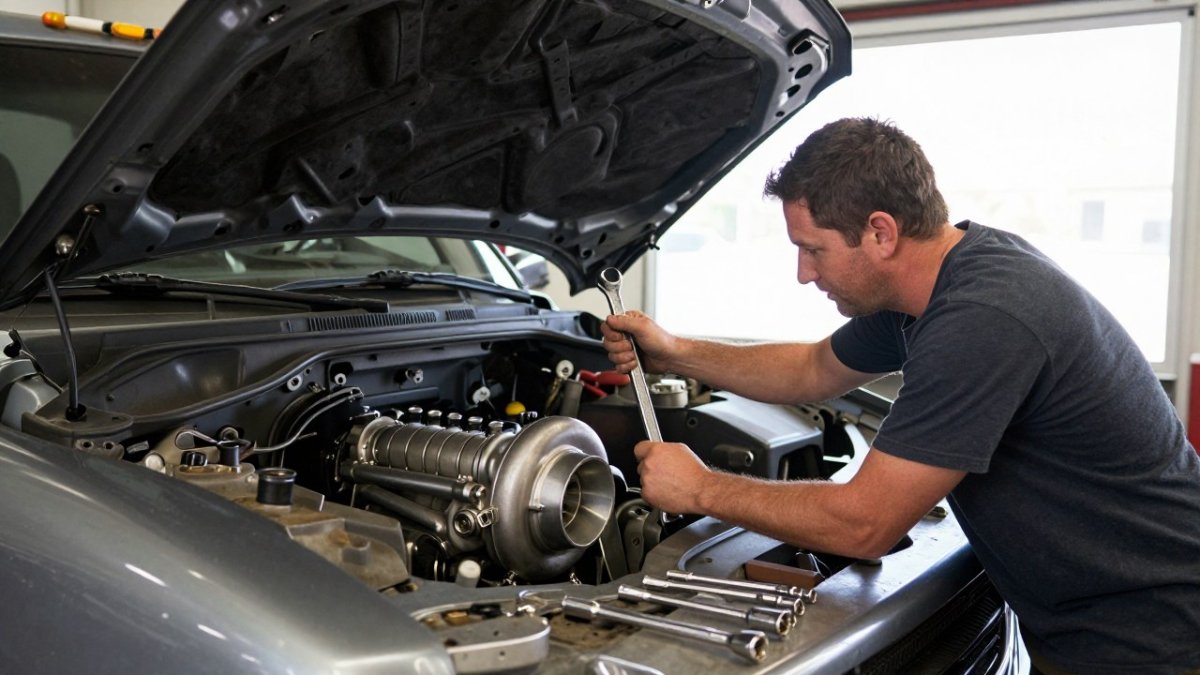
 Ultimate guide
The Ultimate Guide to Performance Upgrades for Heavy Duty Engines
Last Updated: November 14, 2026
Quick Summary
Performance upgrades for heavy duty engines are changes to the powertrain, airflow, fuel delivery, and control software that improve towing power, efficiency, and durability under sustained load. The safe order moves from airflow to fuel to turbo sizing to ECM calibration, matched to your actual duty cycle rather than a horsepower number.
- The global heavy-duty engines market was reported at $58.8 billion in 2026, forecast to reach $78.37 billion by 2030.
- A generic off-the-shelf tune written for a different axle ratio and duty cycle can raise cylinder pressure beyond stock tolerances.
- Start by recording loaded weight, longest regular grade, and part-load versus full-load miles before buying parts.
- Baseline diagnostics come first: compression test, oil analysis, and a scan for stored fault codes.
- Federal rules under 40 CFR Part 86 Subpart A set emissions standards for 2007 and later model-year diesel heavy-duty engines.
Table of Contents
- Why Performance Upgrades for Heavy Duty Engines Matter
- Heavy-Duty Truck ECM Tuning: The Brain of Your Build
- Diesel Engine Upgrades for Towing: Matching Power to the Load
- Volvo D13 Performance Upgrades: What Works and What to Skip
- Upgrade Sequencing and Compatibility: Building It Right the First Time
- Emissions Compliance and Legal Considerations for Heavy Duty Engines
- Long-Term Value, Durability, and What to Expect
- Choosing a Shop for Your Heavy Duty Engine Upgrades
- Frequently Asked Questions
Why Performance Upgrades for Heavy Duty Engines Matter
Performance upgrades for heavy duty engines are the changes made to a commercial truck's powertrain, airflow, fuel delivery, and control software to improve towing power, efficiency, and durability under sustained load. This guide from Extreme Sport Chassis breaks down what works, what to skip, and how to sequence a build that holds together.
The stakes are real. The global heavy-duty engines market was reported at $58.8 billion in 2026, with a forecast of $78.37 billion by 2030 at a 7.4% CAGR, according to The Business Research Company's market forecast. That growth reflects how much fleets and owners now invest in the engine itself.
Not sure whether your rig qualifies as heavy duty in the first place? What Makes a Truck Heavy Duty? Classes and GVWR Explained covers the class thresholds before you spend a dollar on parts.
Heavy-Duty Truck ECM Tuning: The Brain of Your Build
Heavy-duty truck ECM tuning is the recalibration of the engine control module, the computer that governs fuel timing, boost pressure, and torque delivery. It is the single highest-use upgrade because it coordinates everything bolted on around it.

Tuning is a mainstream upgrade, but it does not mean every tune is safe.
Watch out: a generic off-the-shelf tune written for a different axle ratio and duty cycle can raise cylinder pressure beyond what the stock pistons and head gasket tolerate. Match the calibration to your load, not to a horsepower number.
Diesel Engine Upgrades for Towing: Matching Power to the Load
Diesel engine upgrades for towing should be chosen by duty cycle first and horsepower second. A rig pulling a horse trailer on weekends needs different torque delivery than a contractor's truck hauling equipment all day, and the same part can be a smart buy in one application and a liability in another.
Start by writing down three numbers: the loaded weight you actually pull, the longest grade you regularly climb, and the percentage of miles run at part load versus full load. Those three figures decide which upgrades earn their place.
- High-flow intake and charge-air system: lowers restriction and intake temperature under sustained boost. The charge-air cooler matters more than the filter on a truck that climbs loaded grades, because intake temperature drives exhaust gas temperature and cylinder pressure.
- Exhaust-system upgrades: reduce backpressure so the turbo spools with less effort. On a stock calibration, a freer exhaust mostly lowers exhaust gas temperature; the power gain comes only after the tune can use the reduced restriction.
- Turbocharger and performance turbo changes: add airflow only when fuel delivery can support it. An oversized turbo on a part-load truck spools late, raises intake temperature, and can hurt fuel economy in the exact duty cycle most owners run.
- Fuel injectors and high-pressure fuel pump: deliver the volume a bigger turbo demands. Injector sizing must match the airflow target; too large and the engine runs rich and smokes, too small and the turbo is starved.
- Camshaft and pistons: supporting engine components for serious builds. These are the last parts to change, not the first, because they set the ceiling for everything upstream.
A common mistake is bolting on airflow before addressing fuel delivery, which leans out the mix and raises exhaust temperature. The opposite mistake, adding fuel before airflow, raises exhaust gas temperature even faster and is the usual cause of cracked exhaust manifolds and warped cylinder heads on tuned trucks. A safe upgrade order generally moves from airflow to fuel to turbo sizing to calibration, which is why the sequencing section below matters as much as the parts list.
Duty cycle changes the recommendation. A long-haul truck that runs steady at highway speed benefits most from intake and exhaust efficiency plus a conservative tow tune. A vocational truck that idles and runs stop-and-go benefits more from cooling-system and charge-air upgrades than from peak horsepower. An agricultural or off-road truck that rarely sees a scale can accept a more aggressive calibration, but it still has to pass any applicable emissions inspection.
Protect the rest of the drivetrain with how to avoid drivetrain issues when hauling heavy loads.
Volvo D13 Performance Upgrades: What Works and What to Skip
Volvo D13 performance upgrades reward restraint. The D13 is a workhorse platform, and efficiency gains come from airflow, fuel delivery, and calibration working together, not from one dramatic part.
Worth doing: a quality intake system, an upgraded charge-air cooler, and a calibration matched to your actual hauling weight. Skip oversized turbos on a truck that mostly runs part load. A National Highway Traffic Safety Administration study found that the contribution of one auxiliary power technology to overall engine performance was relatively limited, particularly at part load, which is a useful reminder that more hardware does not always mean more usable power.
See a real example of a heavy-duty powertrain in a luxury hauler: 2025 Freightliner LH5 SportChassis.
Upgrade Sequencing and Compatibility: Building It Right the First Time
Upgrade sequencing is the order in which parts go on, and it decides whether a build is reliable or a pile of mismatched components. Get the order wrong and each part fights the next: a turbo sized for airflow the intake cannot deliver, or injectors flowing more fuel than the turbo can burn, produces heat instead of power.
Here is the sequence most practitioners recommend, with the reason each step depends on the one before it:
| Stage | Upgrade | Why It Comes Here |
|---|---|---|
| 1 | Baseline diagnostics and health check | Confirms the engine is sound before adding power. A compression test, oil analysis, and a scan for stored fault codes catch problems that a tune would otherwise amplify. |
| 2 | Intake and exhaust airflow | Removes restriction the tune can then use. Measure intake restriction and exhaust backpressure before and after so you know the change is real. |
| 3 | Fuel delivery: injectors, high-pressure pump | Supports the airflow you just added. Injector size is chosen against the airflow target, not against a horsepower number. |
| 4 | Turbocharger upgrade | Sized last, to match real airflow and fuel. A turbo chosen before stages 2 and 3 is a guess. |
| 5 | ECM calibration | Ties the whole package together. The calibration is written for the hardware actually installed, including axle ratio and tire size. |
| 6 | Verification and monitoring | Confirms gains and catches problems early. Compare baseline and post-upgrade horsepower, torque, fuel consumption, and exhaust gas temperature under the same load and grade. |
Compatibility failures follow predictable patterns. An intake that flows more than the mass airflow sensor can meter causes a lean condition the calibration cannot correct. A turbo upgrade without a matching charge-air cooler raises intake temperature and pulls timing exactly when the engine is working hardest. Injectors sized for a race build on a tow truck smoke at low load and wash cylinder walls. Each of these is avoidable by measuring before buying.
Watch out: a calibration written for a different axle ratio and tire size will report the wrong speed and load to the transmission, which can change shift points and torque-converter lockup in ways that shorten drivetrain life.
Testing is the part most builds skip. A baseline dyno pull and a loaded-grade run before any parts go on give you the numbers to judge every later change. After each stage, repeat the same run and log horsepower, torque, fuel consumption, and exhaust gas temperature. If a stage does not move the numbers in the expected direction, stop and diagnose before adding the next part. That discipline is what separates a build that lasts from one that peaks once and fails on a grade.
Emissions Compliance and Legal Considerations for Heavy Duty Engines
Emissions compliance is not optional, and it is where many aftermarket builds quietly fail. Federal rules under 40 CFR Part 86 Subpart A set emissions standards and supplemental requirements for 2007 and later model-year diesel heavy-duty engines and vehicles.
The EPA's heavy-duty engine and vehicle test procedure updates aim to improve test accuracy, which means compliance is being measured more closely, not less. The research does not establish that any particular aftermarket modification complies, so verify fitment and legality with your shop before committing.
Long-Term Value, Durability, and What to Expect
Long-term value comes from a build that stays reliable, not one that peaks on a dyno and fails on a grade. Durability lives in the supporting parts: upgraded springs, quality shock absorbers, and a drivetrain rated for the torque you added.
Compare the two directly in custom Sport Chassis vs stock trucks for heavy towing.
Choosing a Shop for Your Heavy Duty Engine Upgrades
Choosing a shop for heavy duty engine upgrades comes down to three things: documented builds, a clear sequencing plan, and a shop that will tell you no. Ask for examples of builds for owners with your exact duty cycle.
Extreme Sport Chassis has been in business since 1987 and has built luxury haulers for the last 20 years. SportChassis is rated in J.D. Power. Read the benefits of professional custom truck builds before you commit.
A performance build only pays off when every part supports the next, and that is hard to guarantee when upgrades are added one invoice at a time. Extreme Sport Chassis offers SportChassis trucks engineered as complete heavy-duty haulers, backed by a wide selection of cars, trucks, Jeeps, and SUVs and a team that tailors each vehicle to your budget and lifestyle. Get started with Extreme Sport Chassis and drive a truck built to haul, not assembled to guess.
Frequently Asked Questions
What modifications add the most horsepower to a heavy-duty diesel engine?
ECM tuning typically delivers the largest gains per dollar, followed by turbocharger and fuel-system upgrades. A high-flow intake and exhaust help supporting airflow. For heavy duty engines, the biggest single jump usually comes from a calibrated tune, but gains vary by engine and duty cycle. Pairing a tune with airflow and fuel upgrades prevents bottlenecks and keeps reliability intact.
Is it legal to delete the DEF system on a heavy-duty truck?
No. Under 40 CFR Part 86 Subpart A, emissions standards and supplemental requirements apply to 2007 and later model-year diesel heavy-duty engines and vehicles. Removing or bypassing emissions equipment can violate federal law and may void warranties. Always confirm compliance before any modification, and choose upgrades that work with the emissions system rather than defeating it.
Which performance upgrades improve torque for towing?
ECM tuning, turbocharger upgrades, and fuel-system improvements (injectors and high-pressure fuel pumps) are the main torque levers. For diesel engine upgrades for towing, prioritize low-end torque and cooling capacity. A calibrated tune that adds torque at towing rpm, plus a high-flow intake and exhaust, gives the most usable pull without overstressing the drivetrain.
Can diesel tuning improve fuel economy in a heavy-duty truck?
Tuning can improve fuel economy when it optimizes injection timing and airflow for your duty cycle, but results vary. A tune designed for towing may trade some economy for power. Real gains come from matching the calibration to how you use the truck, plus supporting airflow upgrades. Measure before and after with the same route and load to see actual results.
What is the best first upgrade for a heavy-duty diesel engine?
Start with ECM tuning from a reputable shop, then add a high-flow intake and exhaust if the tune calls for it. This sequence lets you measure gains and keeps compatibility predictable. For heavy duty engines used for towing, a towing-focused tune is the best first step because it delivers usable power without requiring major hardware changes.